

Companion Animals Grief
Cremation of your Pet
In compliance with Dubai Municipality regulations, animal burial is not allowed in the UAE, but we facilitate cremation services through a third-party service provider.
We absolutely guarantee that after your pet passes on, he or she is looked after correctly and with the dignity and respect that they deserve. He or she will be cremated with their favourite belongings should you wish to do so.
If your pet passes away at home, you can still come to us and we will help you with the cremation process.
There are three cremations options available to you:
- A communal cremation means pets are cremated together with no return of ashes.
- An individual cremation means the pet is individually cremated with the return of individual ashes (multiple pets placed in individually marked and separated compartments). May take up to 2 weeks.
- Personal (private) cremation means the pet is cremated alone with the option of viewing (saying goodbye at the crematorium) and the return of individual ashes (one pet, one compartment). May take up to 3-5 working days.
Please be aware that having your pet privately cremated is more expensive than the standard cremation, so please ensure that you are fully aware of the costs before making your decision.
We will also make a keep-safe memento of your pet’s paw and nose print for you to keep. You may take a lock of hair in a small container if you wish to do so. (an urn / box is provided and style may vary).

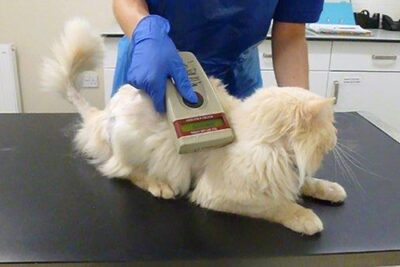
What is a microchip
A microchip is a small electronic chip (rice grain size) inserted/ implanted under your pet’s skin using a special syringe. It is a universal method used to permanently identify your pet. It is normally inserted in the lose skin in between the shoulder blades. Most pets tolerate it and don’t even flinch when it’s happening.
It is important to note that a microchip is not an active tracking device. The chip only contains a unique number which can then be cross referenced with the owners’ details when the chip is inserted and the animal is registered.
The chip is “read” by using a small portable hand-held scanner which is waived over the animal. This picks up the unique number and it means that the owners’ details can then be obtained and contacted.
Companion Animals Grief
YES. Families that live together form close attachments.
When a companion animal dies, surviving pets may “cling” to their human family members, be more reactive to stimuli, appear anxious or depressed, or demonstrate a loss of interest in playing, sleeping, or eating.
These behavioural and emotional changes may be a temporary response to the loss, a distress response to the owners’ sadness, a distress response to changes in routine that occur as the result of the death, or an underlying medical condition.
What signs should I look for
Important Health Alert
If a cat stop eating, this can be a medical emergency. Please contact your veterinarian as soon as possible.
If a dog stop eating, alert your veterinarian.
Watch for changes in the relationships between surviving companion animals; particularly if the surviving pet often looked to the other pet for direction. Such reactions may be more common in species or individuals that show more elaborate social interactions.
It can be stressful whenever members are added or lost from groups of social animals. Remaining animals may begin to show signs of separation anxiety. These behaviours include panting, pacing, whining, drooling, howling, barking, and not eating treats while alone. When your pet is alone, video can be utilized to help monitor and record stress levels.
Exercise is the best non-drug stress reliever you have available for your pet. It can also be a helpful tool in managing your grief response. Prior to beginning a new exercise program with your pet, consult with your pet’s veterinarian.
There are now pheromones available, in sprays and atomizers, and collars, which may be effective tools for reducing your pet’s anxiety. Adaptil (DAP- dog appeasing pheromone) is a replication of the pheromone that a mother dog releases while nursing her young. For cats, Feliway is a replication of the calming cheek marking pheromone. Many veterinary clinics have those available.
For the most part, allow the companion animals to work out their own relationships. Punishment should be avoided as it increases levels of anxiety, fear, and aggression. Instead, try rewarding positive behaviours and interrupting undesired ones with obedience commands or redirection to a new activity.
Common underlying medical conditions can contribute to behavioural changes. A thorough medical examination may be needed to rule out these conditions.
If you have any questions or concerns regarding changes in a surviving companion animal’s behaviour, consult with your veterinarian, a veterinary behaviourist.
Our Location
Villa 4, Al Wasl Rd
Umm Al Sheif – Dubai
Contact Us
Got Questions?